Welcome to ECOSTRESS
News Flash: ECOSTRESS has received approval for operations through FY2026 with potential continued operations until FY2029, subject to a successful 2026 Senior Review!
News Flash: ECOSTRESS has now acquired over 620,000 scenes (after In Orbit Checkout)
ECOSTRESS acquires high resolution temperature and emissivity (composition) images of the Earth's surface. These are used for a variety of applications including:
- Determining how much water to put on fields for maximum crop with minimum water use
- Mapping wildfires and volcanic hazards
- Improving urban development and infrastructure
- Discovering critical mineral resources
Plants regulate their temperature by releasing water through tiny pores on their leaves called stomata. If they have sufficient water they can maintain their temperature, but if there is insufficient water, their temperatures rise and this temperature rise can be measured with ECOSTRESS. The images acquired by ECOSTRESS are the most detailed temperature images of the surface ever acquired from space and can be used to measure the temperature of an individual farmers field.
One of the core products that will be produced by ECOSTRESS team is the Evaporative Stress Index (ESI). ESI is a leading drought indicator - it can indicate that plants are stressed and that a drought is likely to occur providing the option for decision makers to take action.
ARSET Urban Heat Training with ECOSTRESS
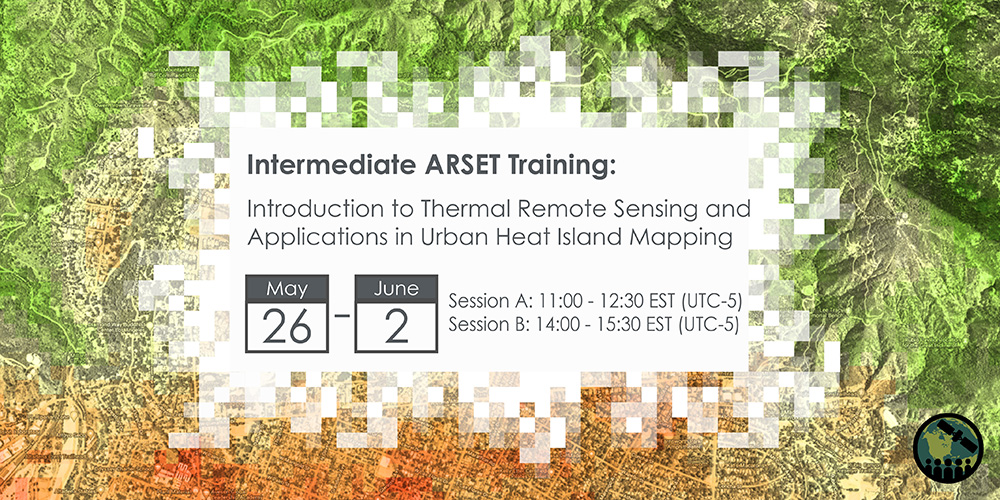
NASA’s Applied Remote Sensing Training Program (ARSET) has opened a new open, online webinar series: Introduction to Thermal Remote Sensing and Applications in Urban Heat Island Mapping. This two-part intermediate level training introduces the fundamentals of Thermal Remote Sensing and its applications in urban planning along with highlighting its ability to quantify the effects of the urban heat island.
If you would like to join us or pass along to colleagues who will find it useful, please do so. Please see the training details and registration information below.
Introduction to Thermal Remote Sensing and Applications in Urban Heat Island Mapping
Extreme heat events are defined as prolonged periods of excessively high temperatures for multiple consecutive days. According to the World Health Organization (WHO), heat stress is the leading cause of weather-related deaths and can exacerbate accidents, underlying illnesses, and the transmission of some infectious diseases. This intermediate-level training equips participants with the foundational theory and practical skills to leverage thermal infrared (TIR) remote sensing to quantify these risks.
The course begins by establishing the physical principles of TIR, including emissivity and blackbody radiation. While these fundamentals are broadly applicable to numerous applications, this training specifically focuses on using data from NASA’s Ecosystem Spaceborne Thermal Radiometer Experiment on Space Station (ECOSTRESS) to identify heat-vulnerable communities and quantify urban heat island (UHI) effects.
In the hands-on component, participants will process ECOSTRESS Land Surface Temperature (LST) data in R – including quality filtering and time-of-day subsetting – and apply the interactive ECOSTRESS LST Downscaling Tool in Google Earth Engine. This tool uses a random forest model to enhance spatial resolution from 70 m to 10 m, translating satellite observations into street-scale thermal maps suitable for urban planning, strategic greenspace placement, and extreme heat early warning systems.
No prior programming experience is required.
Learning Objectives:
- Identify the fundamental concepts and physical principles of thermal infrared remote sensing;
- Define the role of emissivity retrievals in ensuring the accuracy of satellite-derived land surface temperature products;
- Distinguish key differences between thermal and optical remote sensing approaches, including emission versus reflection, day/night capability, and atmospheric window considerations;
- Identify applications of thermal remote sensing data for ecosystems stewardship, agricultural management, climate adaptation, and urban planning;
- Compare the characteristics of current and upcoming thermal missions in context of their suitability to different application uses;
- Filter and visualize ECOSTRESS Land Surface Temperature (LST) data using provided R-based data processing workflows;
- Downscale native 70 m ECOSTRESS LST data to a fine 10 m spatial resolution using a Random Forest machine learning model implemented on an interactive Google Earth Engine (GEE) interface to analyze neighborhood-level urban heat patterns.
Course Dates: May 26 & June 2, 2026
To Register: https://go.nasa.gov/3ZF7D3a
Audience:
- Primary Target Audience: Urban planners, climate adaptation practitioners, and climate researchers who work with satellite data and have applied remote sensing knowledge. Participants should be comfortable with intermediate-level data analysis and have some experience with Python or the willingness to follow along with code examples.
- Secondary Target Audience: Graduate students in environmental science, geography, or related fields; government personnel working on forest monitoring, urban heat mapping, or climate adaptation; and NGO staff involved in conservation and climate resilience projects.
Course Format: Two 1.5-hour parts including Q&A.